
Bloating and Constipation: What Helps When Your Gut Feels “Stuck”
Bloating and constipation are two of the most common, and most frustrating, digestive complaints I see in pelvic health. They can affect comfort, energy, pelvic floor function, and even pain levels in the abdomen and pelvis. The good news is that many of the factors influencing digestion are modifiable through posture, breathing, movement, and routine.
Let’s break it down:
MANAGING BLOATING
1. How you eat matters more than you think
Your body digests food best when it is in a relaxed, open position.
Common position:
Leaning forward over your food
Chin tucked down toward chest
Tight abdomen while eating
This can:
Narrow the esophagus
Increase swallowed air (a major contributor to bloating)
Reduce efficient swallowing and digestion
Better strategy:
· Sit upright with ribs stacked over pelvis
· Bring food toward your mouth instead of folding forward
· Take a moment to “open” your rib cage before eating (gentle trunk rotation or deep breath)
2. Chewing is part of digestion
Digestion does not start in the stomach; it starts in the mouth.
Chewing:
Activates digestive enzymes
Reduces food particle size
Improves absorption
Reduces fermentation and gas production downstream
If food is not well-chewed, your gut has to work harder, which can increase bloating.
3. Slow down your eating pace
Fast eating often leads to:
Increased swallowed air
Poor digestion signaling
Overloading the digestive system before it can respond
Try this:
· Pause halfway through meals
· Put utensils down between bites
· Check in with fullness and tension levels
4. Abdominal and diaphragm tension
The diaphragm and abdominal wall play a role in both breathing and digestion.
If the abdomen is chronically tense:
Digestion may feel restricted
Bloating may increase
The belly may feel distended or “stuck”
Helpful reset:
· Hands-and-knees position
· Let the belly fully soften toward the floor
· Slow diaphragmatic breathing
MANAGING CONSTIPATION
1. Toilet posture matters
The rectum empties more efficiently when the angle is optimized.
Best position:
· Knees elevated above hips to help relax pelvic floor muscles
· Feet supported
· Slight forward lean (with relaxed belly)
Tools like a squat stool can help improve this position.
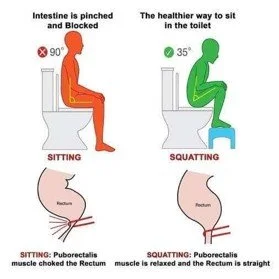
Be aware: while the comfort height (raised) toilet seats might be easier for mobility for people struggling to get on and off the toilet, they can increase issues with constipation. I strongly encourage having a stool under your feet with these height seats.
Also note: if you frequently get up in the night to use the bathroom, move the stool out of the way before going to bed so nobody trips over them while groggily making their way to the bathroom.
2. Avoid straining or bearing down
Straining increases:
Pelvic floor pressure
Risk of hemorrhoids
Pelvic floor dysfunction over time
Instead:
· Use gentle breathing
· Think “blowing bubbles” or “pinwheel breath”
· Allow the body to do the work rather than forcing
3. Build consistency
The gut responds well to routine.
Helpful habits:
Try to use the bathroom at similar times daily
Respond to natural urges when possible
Avoid repeatedly ignoring bowel signals
4. Hydration and movement (aka mobility is motility)
Both are essential for bowel motility:
Water softens stool
Movement stimulates intestinal activity
Even light walking can support digestion.
5. Gentle abdominal massage
Abdominal massage can help encourage motility.
Try this:
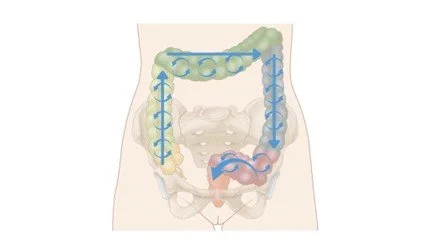
Colon Massage
Lying on back with legs bent to relax tissue.
Massaging inside left pelvic bone to drag along the inside of the pelvic bone
Massage from the top left abdomen down to the inside of the left pelvic bone
Massage top right abdomen, over to top left, down to pelvic bone
Massage inside the right pelvic bone, up to the right abdomen, over top left, and down to left pubic bone
FINAL THOUGHT
Bloating and constipation are rarely caused by just one factor.
They often involve a combination of:
breathing patterns
posture
nervous system tone
hydration
movement habits
Small changes in how you eat, breathe, and move can make a significant difference over time.
Need more help?
Reach out to Dr. Brooke Meinema for individualized treatment to address your specific concerns.
